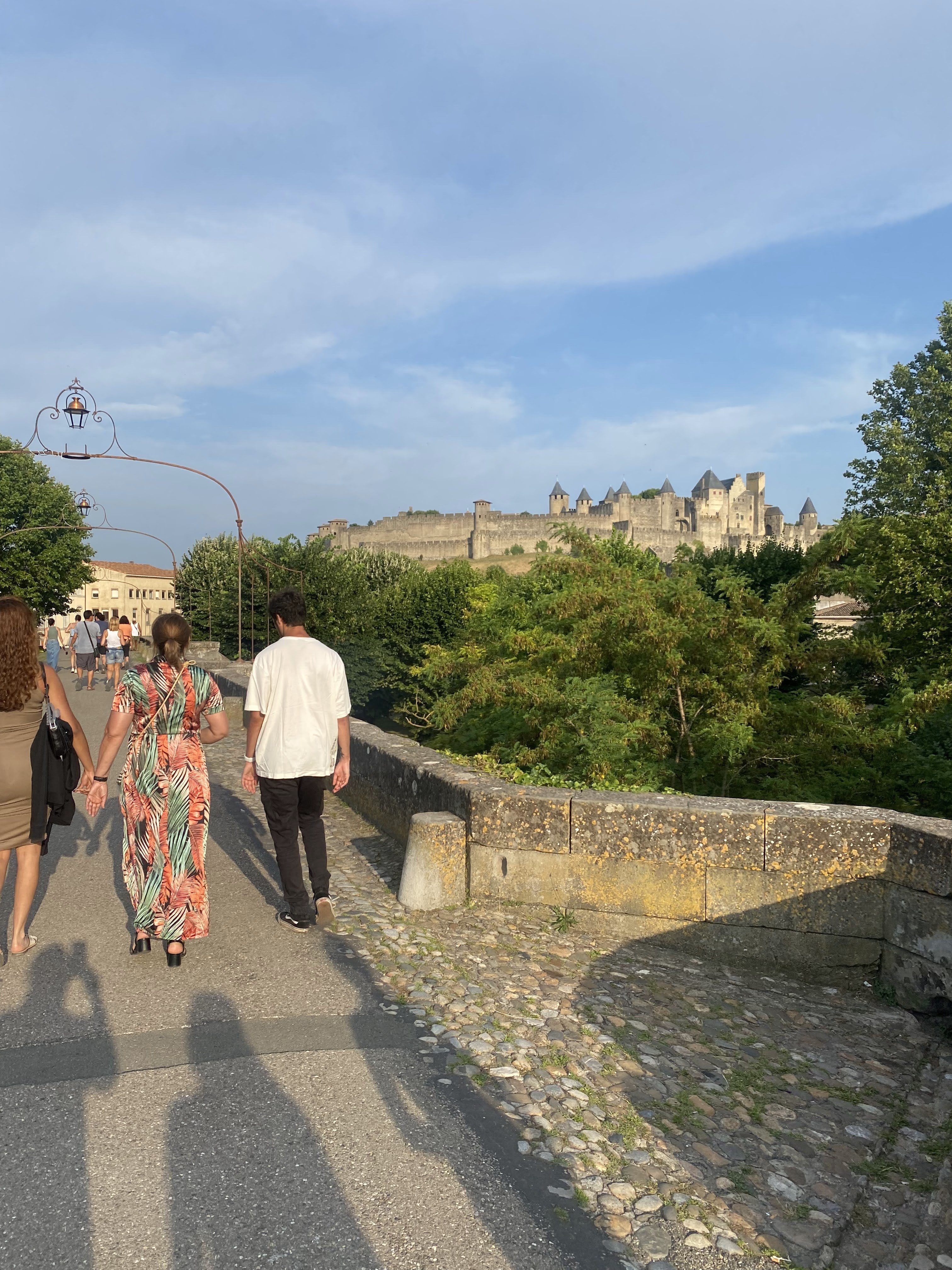
One day in Carcassonne works, as long as you accept the trade-off: you’ll see the city itself well, but not the lake, the vineyards or the villages around it. Most visitors make a different mistake, spending the whole day inside the Cité and leaving at four, never discovering that the best food, the liveliest square and the most surprising view are all on the other side of the river.
Here’s how I’d spend a single day here, hour by hour, as someone who lives in the lower town.
8:30am — Start in the Cité, before anyone else
This is the single most important decision of your day. The Cité between 11am and 4pm in summer is crowded and hot, and the stone radiates heat. At half past eight it’s almost empty, the light is beautiful, and you’ll have the ramparts largely to yourself.
Walk in through the Porte Narbonnaise, the main gate, and let yourself get lost in the cobbled lanes before the shops open. This is the version of Carcassonne that photographs never quite capture, because it’s the quiet one.
9:30am — The Château Comtal and the ramparts
The Château Comtal is the one paid visit worth making inside the walls. It gets you onto the ramparts, where you walk between the two rings of fortifications with views over the Aude plain and, on a clear day, the Pyrenees.
Allow an hour and a half. If you have children with you, this is the part they’ll remember: towers, battlements, arrow slits, the lot.
While you’re inside the walls, put your head into the Basilique Saint-Nazaire. It takes ten minutes and its gothic stained glass is among the finest in the Languedoc, but most visitors walk straight past it.
11:30am — Cross the river to the Bastide
Now leave. This is where a one-day itinerary either works or doesn’t.
Walk down from the Cité and cross the Pont Vieux, the old bridge over the Aude. It takes fifteen or twenty minutes on foot and the view back at the fortress as you go is the best free photograph in Carcassonne.
You arrive in the Bastide Saint-Louis, the lower town founded in the thirteenth century, where the people of Carcassonne actually live. Wide boulevards, real shops, proper cafés, no souvenir stalls.
12:30pm — Lunch on Place Carnot
Place Carnot is the heart of the Bastide: a broad square lined with plane trees and terraces, with the Neptune fountain in the middle. If it’s a Saturday morning, you’ll have caught the market, which is genuinely one of the best in the region.
For lunch, Le Longchamp on the square does simple, well-executed French cooking in the bouillon style, unpretentious and satisfying. Chez Felix, also on Place Carnot, is a historic bar that works equally well for a quick plate and a glass at any hour of the day.
And if it’s your only meal here, order the cassoulet. Carcassonne sits inside the historic cassoulet triangle with Castelnaudary and Toulouse, and the version here is white beans slow-cooked with duck confit and Toulouse sausage, baked until the top crusts. It’s heavy, it’s superb, and it’s the reason to skip a light lunch.
2:30pm — Climb the tower nobody knows about
After lunch, the tower of the Église Saint-Vincent. It’s 232 steps, it costs €2.50, and it gives you a panoramic view over the whole city and the countryside beyond, with the Cité sitting on its hill across the river.
Almost no visitors do this. It’s the best view in Carcassonne and you’ll likely have it to yourself.
If the climb doesn’t appeal, Les Halles, the covered market, is nearby and worth twenty minutes for the local cheeses, charcuterie and regional produce.
3:30pm — Explore the Bastide as a game
If you’d rather do something than simply look at things, this is the slot for it. I’ve created a self-guided treasure hunt through the Bastide: a trail of nine riddles following the story of a merchant’s chest that vanished in 1688.
It takes about ninety minutes, there’s no app to download, and you start whenever you like. It’s the best way I know to see a neighbourhood properly rather than wandering it at random, and it’s a genuine rescue for anyone travelling with children who have run out of patience with old buildings.
5:30pm — The Canal du Midi
Late afternoon is the right time for the Canal du Midi, Carcassonne’s second UNESCO World Heritage site, which runs past the city just north of the Bastide. The towpath is shaded by hundred-year-old plane trees, so it stays cool when the streets don’t.
Twenty minutes’ stroll is enough to see why it’s remarkable. There’s bike and boat hire near the railway station if you’d like longer.
8:00pm — Come back for the Cité at night
Do not skip this. The Cité lit up after dark, with the day-trippers gone, is a completely different place from the one you saw this morning. You can walk up, or simply see it from the Bastide, glowing on its hill above the river.
It costs nothing and it’s the thing people remember about Carcassonne.
If you have bad weather
Carcassonne in the rain is still fine. The Musée des Beaux-Arts is small but genuinely interesting on local art and history. Le Comptoir Ludique is a tiny café where you can settle in with a board game over coffee, and Meery Cake and Katia N are both lovely for pastries, the latter with a hidden courtyard. Book ahead for all three, they’re small.
Honestly, one day isn’t quite enough
A day gives you the Cité and the Bastide properly. If you can stretch to a second, it buys you the Lac de la Cavayère, ten minutes away, where locals swim in summer, and the vineyards of the Cabardès, Minervois and Corbières, some of the best in the Languedoc and mostly within half an hour’s drive.
If you can stretch to a second day, take it.
Want a plan built around your interests?
More and more people plan trips with AI now, and I understand the appeal. But a general AI doesn’t know Carcassonne, so it hands you the same list everyone else gets.
That’s why I built my own itinerary generator: the speed of AI, using my local recommendations. Tell it how long you’re staying and what you’re interested in, and it builds you a plan day by day.
Where to stay
If you’re staying over, the Bastide Saint-Louis is where I’d base you: the restaurants, the market and the canal are all on your doorstep, parking is far easier than up at the Cité, and the walk across the bridge to the medieval city is a pleasure rather than a chore.
See my apartments in Carcassonne →
Any questions about planning your day in Carcassonne? Just write to me.
Leave a Reply